
The usual trigger for hiring a conversion rate optimization consultant is a stale landing page and a testing calendar nobody fills. Both are the wrong reason. The right trigger is one conversion event with enough weekly volume to answer a question, a named person who can kill a losing variant, and a CRM that records what happened to the lead three months later. Without those three, the first month of a retainer produces opinions dressed up as a roadmap.
That moves the fee question to second place. A B2B company between $1M and $50M in revenue rarely carries an optimization budget line, so the money comes out of paid media. Every dollar spent on a consultant is a dollar not spent on traffic, and the consultant has to return more pipeline than those ads would have.
We've watched this fail in a specific way. A company buys six months of testing, runs fourteen variants against a button colour and a hero headline, and finishes with a prettier page and no better understanding of why buyers convert. The tests weren't the problem. The brief was.
The rule we work to: a conversion rate optimization consultant is a learning system with a stop rule, not a redesign vendor. If they can't name a test they'd refuse to run, they haven't sized anything.
Two conditions make that rule urgent. AI-referred sessions behave differently from the rest of organic, and privacy-driven attribution gaps mean the easiest conversion to measure is often the wrong one to optimize. Both decide which tests deserve traffic long before a fee gets negotiated.
Table of Contents
- Scope and Cost Before You Sign
- The Test Contract You Should Demand
- How a Typical Engagement Runs
- What Results You Can Cite
- Where Shorter Forms Lose
- When a Winning Test Should Not Ship
- Hire Now or Wait Another Quarter
- Book a Diagnostic or Park the Hire
Scope and Cost Before You Sign
Scope is the number to fix before the fee. A consultant who quotes a retainer before knowing your weekly conversion volume, your sales cycle, and who owns the kill call is pricing their time rather than your answer. Get the scope right and the bands below tell you whether a proposal is sane. Get it wrong and the cheapest retainer on the market still buys a prettier page.
Budget is the tighter gate. WPForms' digital marketing statistics reported that only 10% of marketing teams had a dedicated CRO budget in 2024, while more than 30% allocated nothing to optimization at all. In practice the engagement gets funded by pausing ads, and a flat quarter kills the contract because the comparison against paid traffic is always live.
What the fee bands look like
These are typical market ranges for a B2B company between $1M and $50M in revenue. Use them to spot a proposal priced outside the band in either direction, not as a tariff.
| Engagement | Length | Typical fee band | You should receive | Fits when |
|---|---|---|---|---|
| Diagnostic audit | 3–6 weeks | $6,000–$15,000 fixed | Funnel map, instrumentation gaps, ranked hypothesis backlog | You need a sequenced plan before a retainer |
| Experimentation retainer | 3–6 months | $8,000–$20,000 a month | Two to four tests a month, readouts, rollout or kill calls | Weekly volume can detect a meaningful lift |
| Embedded advisory | Ongoing | $4,000–$9,000 a month | Prioritization, QA of agency tests, metric governance | An in-house team already ships pages |
| Training sprint | 2–4 weeks | $5,000–$12,000 fixed | Test workflow and prompt library the team keeps | Staff will run tests after the sprint |
| One-off page redesign | 2–4 weeks | $5,000–$15,000 fixed | A new page with no experiment | Almost never for this buyer |
The diagnostic is the cheapest way to learn whether a retainer is justified. It prices your measurement debt as much as your testing opportunity: if AI-referred sessions and privacy-driven attribution gaps mean the easiest conversion to count is the wrong one to optimize, that surfaces here instead of mid-retainer. A well-run diagnostic can legitimately end with the recommendation that you fix tracking and wait a quarter. That is a result, not a failed sale.
The one-off redesign is the row to refuse. Someone signs off a new hero section, nobody can attribute the delta, and the next flat month restarts the argument.
Before you sign: match one row of that table to your actual traffic and to a named owner. If no row matches, the problem sits upstream of the hire.
Two checks sharpen any proposal. Ask which two tests the consultant would refuse to run and why; a serious shop answers fast because stop rules are part of the system. Then ask for a real readout from a client with comparable conversion volume, inconclusive results included. Trackingplan's conversion optimization approach is a fair benchmark for the measurement half of that conversation, particularly the tracking work that has to finish before a variant is trustworthy. If you are still weighing consultant against agency or hybrid, the way we structure SaaS growth engagements is the comparison to run.
The Test Contract You Should Demand
Hire a lab lead, not a page designer. NN/g's guidance on A/B testing treats the work as a statistical design problem rather than a volume game: before a variant ships, the team states the baseline conversion rate, the minimum detectable effect, the significance threshold (commonly 95%), and the required sample size. It also recommends running each test for at least one to two weeks even when traffic is already sufficient, because day-of-week behaviour can hand a weak variant a fake win on a Tuesday.

For a company between $1M and $50M in B2B revenue, the primary metric should be a qualified opportunity, a sales-accepted lead, or pipeline value per session once the CRM stage is joined. Button clicks, scroll depth and raw form fills are diagnostics. Put that hierarchy in writing and you remove the most common failure in the room, which is a team celebrating a lift in a metric nobody in sales recognises.
Ask these three on the first call: what is the single primary metric, what relative lift is worth the sample it costs, and who is allowed to stop the test.
Keep-or-kill rules get set before launch. A statistically significant winner becomes the new control. An inconclusive test, or a win for the original, keeps the original. Where those three answers are missing from the proposal, you're looking at a redesign with a testing label attached. Our A/B testing best practices guide covers the variant setup mechanics if your team needs a workflow rather than a lecture.
How a Typical Engagement Runs
Seven steps, and no fees inside any of them. This is the workflow we hand over in week one.
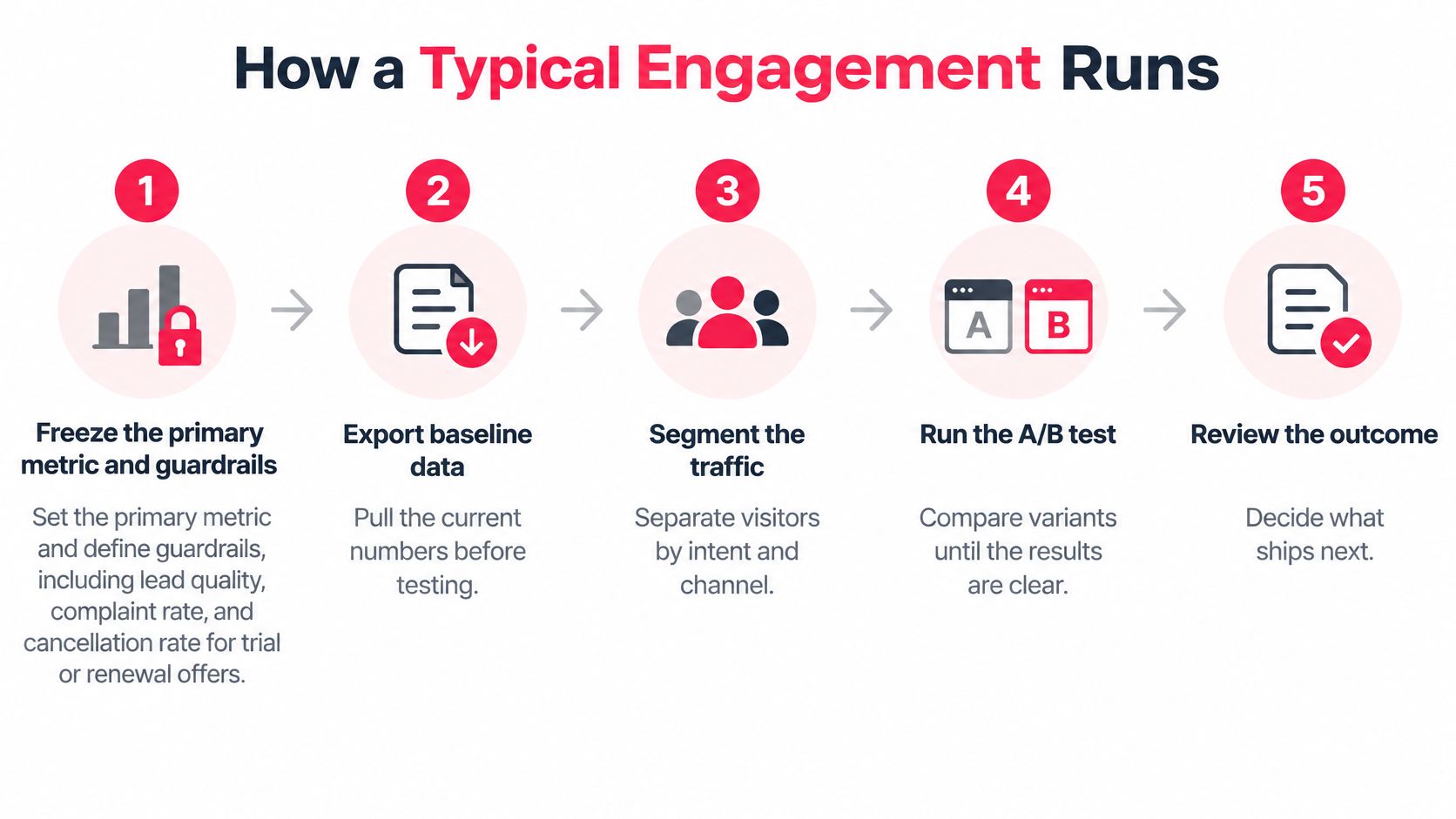
- Freeze the primary metric and the guardrails. Lead quality and complaint rate sit alongside it, plus cancellation rate for any trial or renewal offer.
- Export raw history now. Default retention is shorter than your sales cycle, as the paragraph after this list explains.
- Join product events to CRM stage and source. Give every event one named owner. Unnamed events decay into noise within a quarter.
- Map leakage by device, source and step. Then write hypotheses that name a business mechanism, such as a missing proof point above the pricing table.
- Size each test. If the detectable effect needs four months of your traffic, park it and record why.
- Run the smallest set your team can read. On a site in this band that's often two live at once, not five.
- Read the metric after the pre-set window, then ship or kill and log the learning. Logging the losses is what makes the second quarter faster than the first.
The retention constraint in step two catches teams with long cycles. Standard Google Analytics properties retain user-level and key-event data for only 2 or 14 months, and Google's Analytics data retention page states that data is deleted automatically each month once it reaches that window. Longer retention of 26, 38 or 50 months exists only in Analytics 360. A B2B cycle that runs past a quarter can't be judged against a dashboard that has already dropped last year's cohorts, so export the raw data and connect it to the CRM before anyone touches a page.
The stack is usually the analytics property, a testing tool such as Optimizely or VWO (or a developer-run feature flag on product surfaces), a session review tool, and the CRM. Skip the enterprise testing suite if your monthly conversion count is in the dozens. You'll pay for sampling controls you can't use.
What you should walk away with at the end of week one is a six-week calendar, not a strategy deck. Every row names the test, the page, the primary metric, the sample and the owner who can stop it.
What Results You Can Cite
A 2022 Management Science study of high-technology start-ups found that firms which adopted A/B testing improved performance by about 30% to 100% after one year of use. Read the denominator before you repeat that in a board deck. It's company performance across adopters over twelve months, not a landing-page lift you can paste onto a forecast.
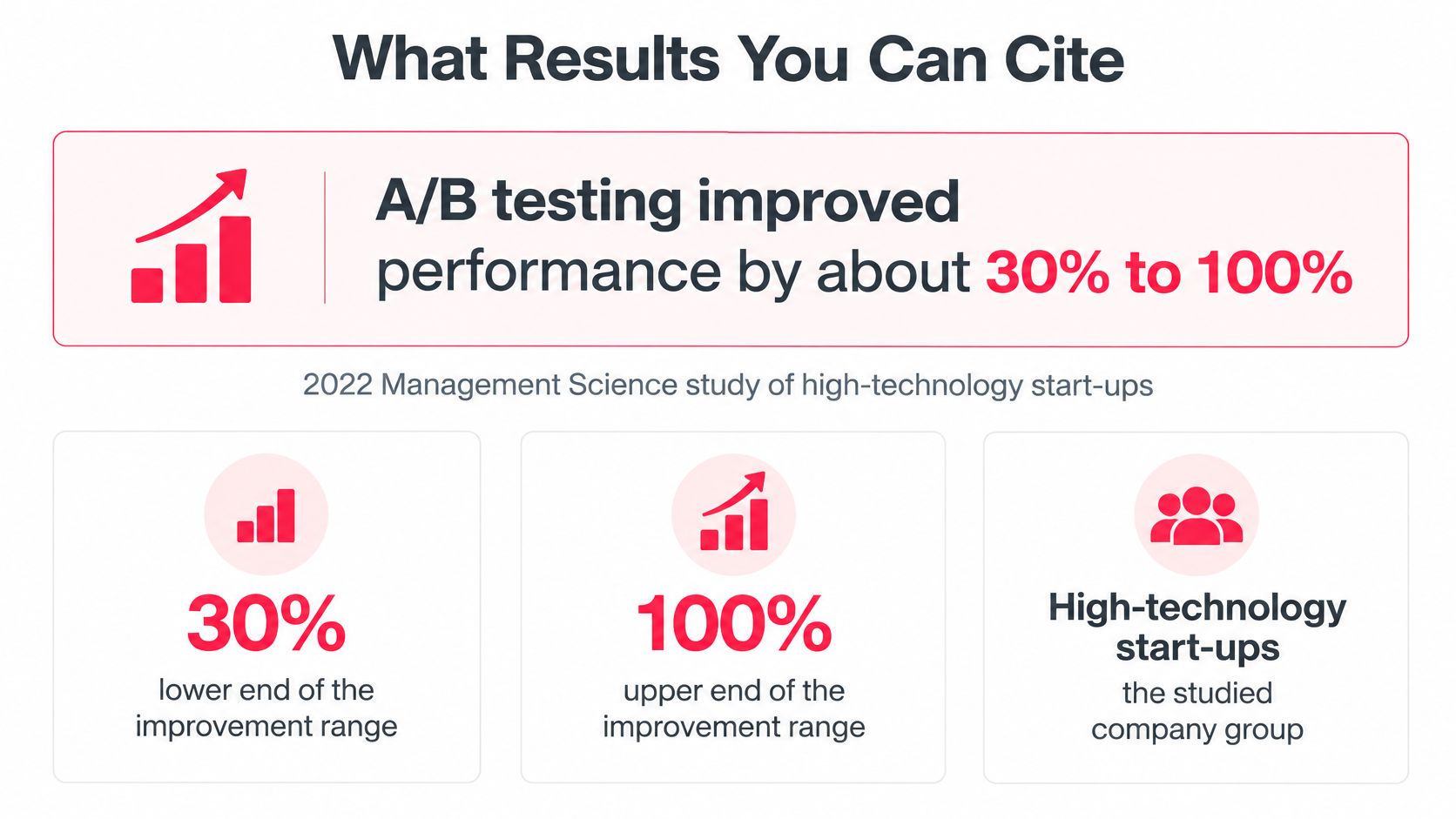
The researchers credited faster learning, more products shipped, quicker scaling of what worked and earlier abandonment of what didn't. They also found that few firms adopted the practice. That's the part worth quoting to a sceptical CFO: the returns showed up where the discipline existed, not where the tool was purchased.
Run the lead-quality arithmetic before kickoff
Illustrative numbers, not client data. A site produces 80 sales-accepted leads a month, and 20% become opportunities, so 16 opportunities. A variant adds form fills and acceptance falls to 12%. At 110 accepted leads that's 13 opportunities. The top-line conversion metric rose and pipeline fell. This is the arithmetic that separates a readout from a press release, and it's why the CRM-stage guardrail sits beside the effect size in the report.
Ask for four columns in every readout: baseline rate, effect size, confidence, and the guardrail metric. Inconclusive belongs in that table as a result, logged with what you learned, not deleted from the slide.
Evidence that every B2B retainer produces something in that 30% to 100% band is thin, and we'd rather say so than imply it. In our own client work the binding constraint is almost always traffic, not ideas. A page with a few dozen conversions a month can't support a multivariate tour, and a consultant who proposes one is billing for activity.
Your test contract already settles the obvious objection: a variant that grows form fills while shrinking accepted pipeline loses, whatever the p-value. Our growth marketing case studies show how that sequencing plays out across live programmes.
Where Shorter Forms Lose
The most repeated advice in this category is to cut fields until the form submits. That advice breaks on the traffic segment most B2B sites now receive. An analysis of 97 B2B lead-generation websites covering 28.9 million sessions, published by Orbit Media, found visitors from AI sources were three times more likely to become leads than other organic visitors, with the median site showing a seven-times advantage.

Form friction is real, which is why the shorter-form default sticks. These sessions are different in kind. They're frequently small, high in intent, and arriving after a model has already put you on a shortlist. A visitor in that state doesn't need fewer fields. They need evidence you do what the summary said, an implementation detail that shows you've done it before, and a comparison against the alternative they were shown.
Split the segment before you split the test
Pooling AI-referred sessions into organic hides the effect entirely. Report AI-referred, branded organic, nonbranded organic, paid and direct separately, and judge each on assisted pipeline and sales-accepted rate rather than form completions.
A channel this small is also easy to overfit. A few dozen AI sessions produce three leads and the dashboard shows a wonderful rate. That's not a winner. It's a sample too thin to act on, and a lesson learned there shouldn't be transplanted to paid traffic without its own test.
Which gives us a hard approval rule. No test brief that pools AI-referred traffic into a single organic segment gets signed off here. If the brief can't say which segment a variant is judged on, the readout will be uninterpretable in both directions, and you'll have spent the traffic for nothing.
When a Winning Test Should Not Ship
A variant can beat control and still be the wrong call. The FTC's negative-option enforcement policy requires businesses to disclose price, charge frequency, deadlines and cancellation terms as prominently as the offer itself, obtain express informed consent before charging, and make cancellation at least as easy as sign-up. A test that lifts conversion by burying the renewal charge fails all three, and the lift is worthless.
The enforcement record prices that mistake. In October 2023 the agency announced nearly $100 million in refunds in its action against Vonage, which it said trapped subscribers through dark patterns, obstructed cancellation and kept charging some customers after termination requests. In its Amazon Prime case, the FTC alleged enrollment without informed consent and described a cancellation flow built to stop subscribers leaving.
So treat ship decisions on subscription offers as a compliance review, not a readout. Instrument enrollment, consent, renewal, cancellation initiation, cancellation completion, refunds and complaints before any checkout or sign-up test runs. Approval needs legal review and a cancellation-completion guardrail, because statistical significance alone is not a stop rule. If your team is still building variant structure, A/B testing best practices covers the setup mechanics. On billing flows specifically, wire every variant so consent capture and cancellation data stay intact. A badly wired variant reaches real money.
Hire Now or Wait Another Quarter
| Condition | Hire now | Wait |
|---|---|---|
| Sample size | Enough sessions to detect a 10–20% relative change in 2–4 weeks | A few dozen conversions a month |
| Decision owner | CRO or CMO can kill a variant | An agency edits pages with nobody accountable |
| Data join | Submissions reach CRM with stage and source | Last-click analytics is the only scoreboard |
| Offer risk | Billing, trial and consent tests have legal review | Renewal or cancellation UI is tested for lift alone |
| Budget durability | The line survives one flat quarter | The fee is funded by pausing ads week to week |
Five conditions, one verdict each. Mark the column that matches your situation and don't average the rows. A company that clears four and fails budget durability should wait.
Two situations we see often in this revenue band. A 40-person SaaS company with a working demo form, a CRM stage model and a decision owner in the CRO seat should buy the diagnostic and then a short retainer. A services firm with a new site, a handful of inquiries a week and last-click as its only scoreboard should fix tracking and tighten the offer before anyone runs a variant. Both are composites from our client engagements, not named accounts.
The 10% to 20% relative change threshold in the first row is a planning assumption we use to size tests, not a published benchmark. Substitute your own once you know your baseline rate and monthly volume.
Book a Diagnostic or Park the Hire
If every hire-now condition holds, commission a three to six week diagnostic and refuse a redesign sold as a retainer. The statement of work should name the primary metric, the export and CRM join, the first hypothesis backlog, and the person who can stop a test. Anything less is a creative project with a testing invoice attached.
If any wait condition holds, park the consultant and spend the quarter on tracking and offer clarity. Cleaning up polluted Shopify traffic data is worth reading even on a non-Shopify stack, because the assumption it attacks, that a session in your analytics belongs to a real buyer in a channel you can name, is the same assumption that breaks segment-level conversion rates everywhere.
Our AI opportunity audit is a deep dive across conversion, search visibility, sales process and data readiness that identifies where AI produces measurable gain and where it currently doesn't. Every recommendation we make ties back to acquisition, monetization or retention, and where an AI initiative can't be connected to one of those, we'll tell you to skip it. We don't take a testing retainer when weekly volume can't support a pre-sized test with a stop rule, which is the contract described in this article and the only one worth signing.
Two next steps, and only two. Send the statement-of-work requirements to two advisors this month, or write down the tracking gap and don't hire anyone yet.
