
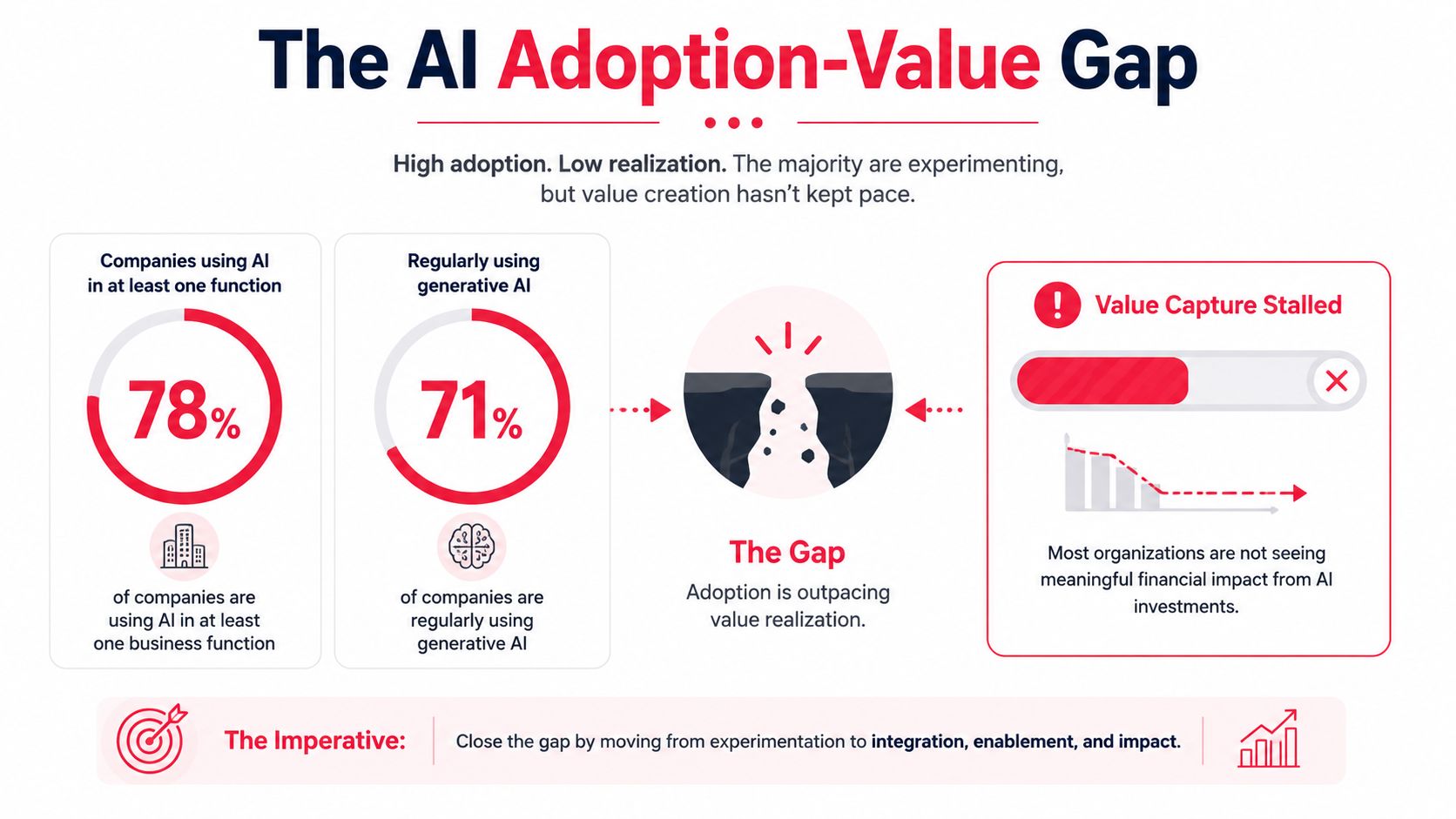
Most AI roadmaps are too early on adoption and too late on revenue. McKinsey's 2025 survey shows the split clearly, 78% of respondents said their organizations were already using AI in at least one business function, 71% were regularly using generative AI in at least one function, yet nearly two-thirds still had not begun scaling AI across the enterprise, and only 39% attributed any EBIT impact to AI, with most of those saying less than 5% of EBIT came from AI use (McKinsey's 2025 global survey). That gap is the whole story. Adoption is common. Value capture is rare.
For CEOs, CMOs, and CROs, the right response is a revenue-first AI transformation roadmap. That means every use case earns its place by tying to a measurable business outcome, a clean data path, and an execution owner. If the work cannot move conversion rate, pipeline velocity, or qualified demand in a way the team can measure, it stays in the backlog.
That's why AI search optimization matters too. If you're redesigning revenue workflows around AI, your content, discovery, and answer surfaces need the same discipline. The Surva.ai guide to AI search optimization is a useful reference point for teams that want AI visibility to connect to actual demand, not vanity traffic.
Table of Contents
- The AI Adoption-Value Gap
- Phase One: Discovery and Audit
- Phase Two: Prioritize, Measure, and Schedule
- Phase Three: Operating Model and Governance
- Phase Four: Pilot to Scale
- Your Next Steps
The AI Adoption-Value Gap
AI adoption is moving faster than financial proof. McKinsey's survey shows that AI is already in use across many companies, generative AI has moved into regular use, yet enterprise-wide scale is still limited and EBIT impact remains narrow (McKinsey). That is the gap executives need to close if they want AI to show up in revenue, margin, or efficiency, not just in tool usage.
Why adoption stalls before revenue
Many teams stop at access. Marketing gets a writing assistant. Sales gets a research copilot. Operations gets an automation demo. Activity rises, but the core workflow stays the same, so lead sourcing, routing, qualification, and conversion do not change in a way finance can measure.
A practical rule helps here. If a use case does not change a workflow the revenue team already owns, it usually will not show up in the numbers.
The road from pilot to value usually breaks in three places. The data needed for repeatable execution is messy or hard to reach. The team has no agreed metric for success, so no one can say whether the test worked. The work never gets folded into the operating rhythm of marketing or sales, so it stays a side project instead of becoming part of how the team sells.
What a revenue-first roadmap changes
A revenue-first AI transformation roadmap starts with a harder question. Which AI use case will improve a business result leadership already tracks? In a growth-stage company, that can mean faster lead qualification, tighter account research, better routing, cleaner attribution, or more consistent follow-up across the funnel.
The sequencing matters more than the tools. Start with the revenue bottleneck that is already visible, measurable, and close enough to the data layer to improve without replatforming the company. That is the difference between broad adoption and real transformation.
Teams focused on CRO with AI, GTM engineering, AI search optimization, and agent commerce readiness need that discipline even more. Those efforts sit close to revenue, but only when they are tied to specific workflows and measured against a baseline. The Surva.ai guide to AI search optimization is useful here because it frames optimization around business outcomes, not just model capability. A roadmap that cannot name the metric it intends to move is just a list of experiments.
The first screen for any roadmap should be data readiness and revenue potential together. A flashy use case with poor data access will stall. A simpler use case with clear data, clear ownership, and a visible sales or marketing bottleneck can create proof fast. The smartest AI programs start there.
Phase One: Discovery and Audit
Before you choose the first use case, map the terrain. A lot of AI roadmaps fail because leaders assume every team is equally ready. They're not. One team may have clean CRM data and a simple workflow. Another may have fragmented records, manual approvals, and no clear owner for the process.
Score the five capability areas
Start with five dimensions, data maturity, infrastructure capacity, governance capability, regulatory exposure, and organizational readiness. CodeGeeks recommends that readiness assessments examine those capability areas before anything else, and then feed the results into a roadmap built around strategic objectives, use-case prioritization, pilot success metrics, scaling strategy, and operational oversight (CodeGeeks).
Use a simple scorecard with three labels, starting, developing, and advanced. The point isn't precision theater. The point is to expose your weakest link.
- Data maturity: Check whether the data exists, whether fields are populated consistently, and whether teams can access it without manual extraction.
- Infrastructure capacity: Review where the data lives, how quickly it moves, and whether your current stack can support pilots without brittle workarounds.
- Governance capability: Identify who approves data access, who reviews model outputs, and who owns escalation when something goes wrong.
- Regulatory exposure: Map the workflows that touch customer data, personal data, or regulated markets.
- Organizational readiness: Ask whether the revenue team has a process owner, a test cadence, and room to change behavior when the pilot proves useful.
A pilot on weak data doesn't stay small for long. It turns into cleanup work with a demo attached.
Read the workflow, not the org chart
A functional org chart can hide significant risk. A sales team may own the pipeline number, but if marketing owns the data, RevOps owns the routing, and legal controls the review step, the actual readiness depends on process coordination, not department labels. That's why a use-case-based audit works better than a function-based one.
For a practical shortcut, use the Stimulead AI readiness assessment to pressure-test the current state before you spend time on tools. If you also want a sales-side lens on what to measure, the sales enablement KPIs for 2026 piece is useful as a metric reference when you're defining the right baseline.
The output of this phase should be a ranked list of gaps. That list decides sequencing. If governance is weak, you don't start with the most regulated use case. If data is inaccessible, you don't start with the most complex workflow. The first win should be the one your organization can absorb.
Phase Two: Prioritize, Measure, and Schedule
Once the audit is complete, the next move is ruthless prioritization. Too many teams fill a backlog with ideas that sound exciting but will never move revenue. A stronger roadmap treats each use case like an investment memo. Score it. Define the metric. Set the review date before anyone starts building.
Use a feasibility-impact matrix
Start with a simple matrix built on four inputs, revenue impact, data availability, integration complexity, and time to value. The highest-priority use cases are usually the ones with usable data, a clear commercial outcome, and low friction in the current stack. In practice, that means you prioritize the work that can show revenue movement without requiring a long cleanup project first.
The matrix should produce a short list, not a long debate. If you cannot rank the top three use cases, the revenue problem is still too vague. That is where many AI programs stall. The team argues about potential while the business waits for proof.
Define the metric before the build
Microsoft's 2024 roadmap frames AI transformation around five drivers, business strategy, data, technology, security/governance, and organizational adoption (Microsoft). Use those drivers as a gate check for each shortlisted idea. If the use case supports strategy but the data is not ready, park it. If the data is ready but the security review is unresolved, hold it. If adoption is weak, revise the rollout plan before launch.
Measure against revenue-facing KPIs. For marketing, that may mean conversion rate, demo request quality, or speed to qualified lead. For sales, it may mean pipeline velocity, meeting acceptance, or reply quality. For agent commerce readiness, the metric may be whether the buying journey can be supported without human handoffs at every step. The point is simple. If the metric cannot show revenue movement, it is a vanity signal, not a roadmap anchor.
The COMPEL Framework adds another useful lens with four horizons, Foundation, Design, Execution, and Optimization (COMPEL Framework). Put your roadmap against those horizons so leadership can see whether the work is still forming the base, being built, being deployed, or being tuned. That keeps the conversation honest about what the organization is ready to do.
Schedule the roadmap in phase-gates
A practical cadence is simple. Run a 4 to 6 week pilot window, then hold a scaling gate, then a full-rollout gate. A three-stage rhythm of quick wins, scaling, and enterprise embedding is a common execution pattern in enterprise roadmaps, with KPI baselines set before deployment and exit tests required before advancing phases (TunerLabs).
Commercial rule: if the pilot does not have a decision date, it will drift until everyone loses interest.
The roadmap itself should fit on one page. Put the use case in the top row. Put the success metric and owner in the middle. Put the phase-gates and review date at the bottom. That is enough to force a decision and keep leadership focused on value, not theater.
For teams that need a clearer control layer, a practical AI governance checklist can keep prioritization tied to approval paths, data ownership, and rollout timing. That matters because a use case with strong revenue potential can still fail if no one knows who can approve it, who owns the inputs, or when it moves to the next gate.
Phase Three: Operating Model and Governance
A roadmap without an operating model falls apart fast. The key question is who gets to say yes, who watches the data, and who stops the rollout when the inputs go bad. If those answers are vague, the team either over-controls everything or lets shadow AI spread inside the business.
Build for decision rights, not bureaucracy
The useful governance model is light and explicit. A pilot approver, a data-quality owner, a scaling sign-off owner, and a risk reviewer should all be named before work starts. That keeps decisions moving without creating a committee that needs a meeting to approve every test.
Graph Digital recommends a portfolio view of current AI investment before new work is approved, along with a board structure that covers where you are, what you know, what you recommend, and what comes next, plus a 12-month milestone structure organized around decision gates (Graph Digital). That approach works because it forces the organization to keep asking whether an initiative should be kept, killed, or scaled.
A functional roadmap usually assigns AI by department. A use-case roadmap assigns AI by data readiness and business value. The second model is more honest. It lets the marketing team and the sales team move at different speeds depending on the quality of their inputs.
Keep build, buy, and governance in the same room
Vendor decisions matter more than many admit. If you buy a tool that can't fit your existing workflow, you'll spend months forcing it into place. If you build everything from scratch, you'll slow the team down and burn attention on custom work that doesn't create differentiation.
The right answer often sits in the middle. Buy where the workflow is standard. Build where the revenue motion is specific. Then keep governance close enough to catch data issues, access problems, and review gaps early. For teams looking for a practical operating model in marketing and sales, Stimulead's AI Growth Partnership is one option, since it combines an audit, a prioritized roadmap with KPIs, and ongoing fractional CAIO oversight.
If you want a second reference for governance guardrails, the Stimulead AI governance best practices resource is a useful companion when your team is deciding who owns risk review, model approvals, and escalation paths.
Train for workflow change, not tool familiarity
Enablement has to be tied to the work. A marketer should know how AI changes account research, content briefs, and attribution cleanup. A rep should know how AI changes prospecting, note-taking, and follow-up. If training stops at tool tours, behavior won't change.
The roadmap should define review cadence, escalation paths, and what gets measured at each gate. That keeps the operating model stable while the use-case backlog changes. It also reduces the chance that a successful pilot gets stuck because no one knows who can authorize the next step.
Phase Four: Pilot to Scale
Most AI roadmaps break at this stage. The pilot looks promising, the team gets excited, then rollout exposes data gaps, workflow conflicts, or approval bottlenecks. Scaling only works when the pilot was built to withstand real operating pressure and still tie back to revenue.
Run one pilot like a real business test
A strong pilot starts with a baseline. Measure the current process before AI touches it. Then run the pilot for a short window, compare results with A/B testing or pre-post measurement, and check whether the metric moved in the direction that matters. A practical enterprise pattern is to start with only 1 to 3 pilots, define business KPIs up front, and prove ROI on at least one pilot before scaling (AI Assembly Lines).
The first pilot window should be tight enough to force learning. Four to six weeks is often enough to see whether the workflow is usable, whether the team adopts it, and whether the data holds up under pressure. If a pilot runs longer than that without a decision, the metric was probably too loose or the review cadence was too slow.
Make the exit criteria explicit
Before the pilot begins, write down the conditions for moving ahead.
- Performance criteria: The pilot must move the agreed KPI against the baseline.
- Data quality criteria: The data must be stable enough for repeat use without manual rescue.
- Governance criteria: The right approvers must sign off on risk, access, and monitoring.
- Operational criteria: The workflow must fit the team's day-to-day cadence.
- Transfer criteria: The team must be able to run it without the builder sitting in every meeting.
That is how you avoid “shadow AI,” where people keep using a tool because it helps them, but nobody has governed it. It also keeps the pilot tied to measurable revenue work instead of turning into a side project.
Phase by readiness, then widen the circle
The strongest portfolio sequence follows data readiness first, function second. If the marketing data is cleaner than sales data, start there. If a sales sequence has more manual friction but cleaner attribution, start there instead. The point is to choose the use case with the best mix of measurable upside and low integration pain.
For a closer look at applied workflows, the practical AI marketing strategies for B2B article is useful when you are deciding how AI should support demand generation, nurture, and qualification. If your team is building AI agents for sales or service, the Stimulead AI agent use cases page helps frame where agentic workflows make sense and where they do not.
A pilot that the team can repeat, measure against a baseline, and review at a gate is worth far more than a flashy demo that cannot survive contact with the rest of the stack.
Your Next Steps
An AI transformation roadmap is a discipline, not a slide deck. The companies that get value from AI keep the work close to revenue, keep the metrics honest, and refuse to scale a use case until the data and governance are ready.
Start with the highest-priority revenue function in your business, marketing attribution, sales prospecting, or agent commerce readiness. Spend the next two weeks completing the discovery audit, score the gaps, and rank the first three use cases by revenue impact and data feasibility. Then set a 30-minute leadership review and decide which use case deserves the first pilot.
If you want ready-to-use templates for the feasibility-impact matrix, phase-gate criteria, and pilot scorecards, use Stimulead's AI Growth Partnership materials as the working framework. Then book a 30-minute audit call and identify the first high-confidence use case your team can ship, measure, and scale.