
By early 2026, roughly 28% to 34% of mid-market and enterprise B2B sales teams had already deployed at least one AI voice agent for outbound prospecting, up from 11% in 2024, and that gap tells us where the decision sits: use ai sales calls as three separate workflows, or watch them become expensive noise. The right question isn't whether to add voice AI, it's whether pre-call research, live assist, and outbound voice each have their own conversion math, governance, and human review path.
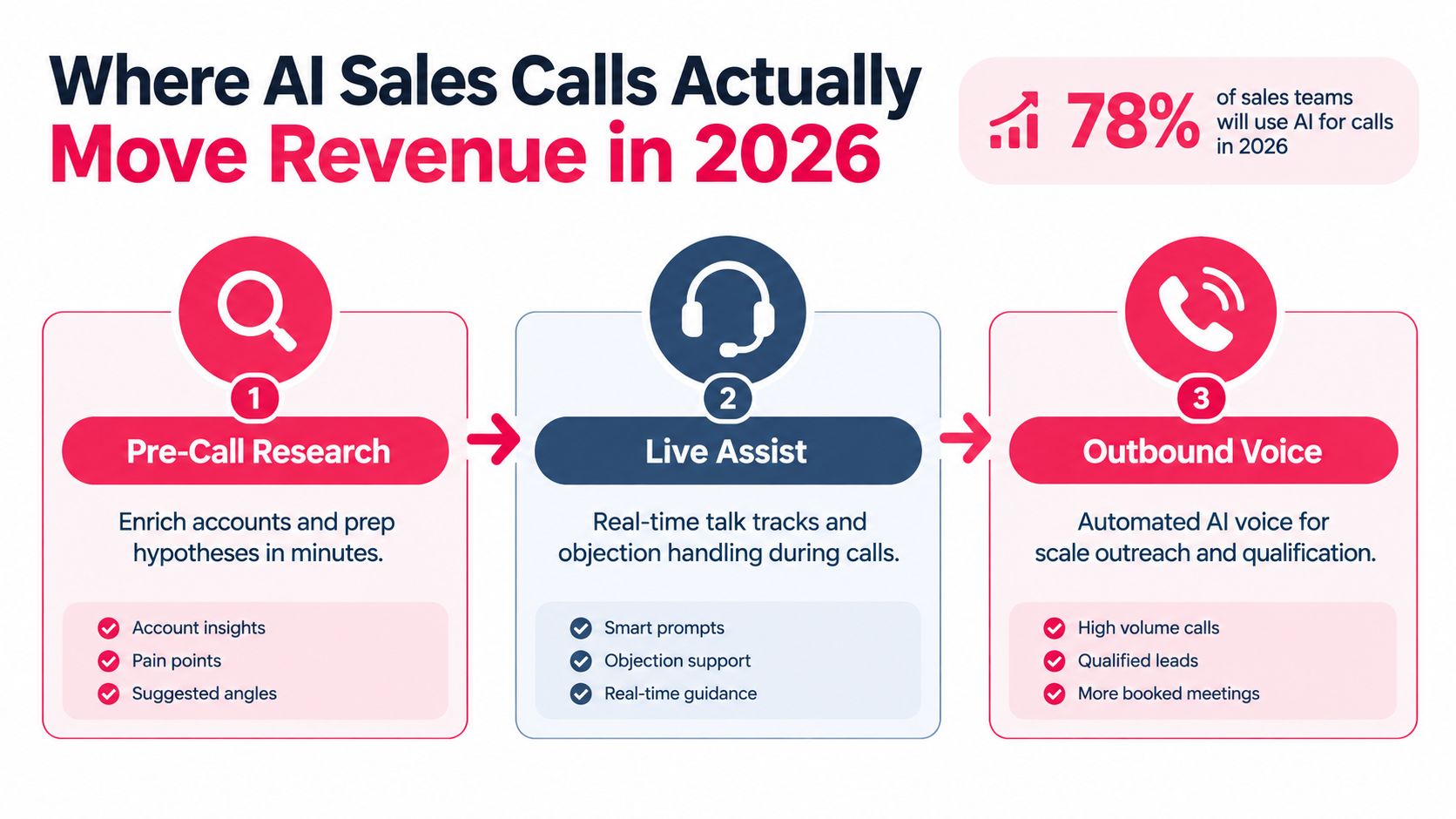
Table of Contents
- Where AI Sales Calls Actually Move Revenue in 2026
- Pre-Call Research That Reps Will Actually Use
- Live Assist Without Turning Reps Into Robots
- Outbound AI Voice Agents and the Conversion Math
- Post-Call Summaries, CRM Hygiene, and Follow-Up Triggers
- What Does Not Work About AI Sales Calls
- Compliance, Governance, and a Vendor Evaluation Checklist
Where AI Sales Calls Actually Move Revenue in 2026
The teams getting value out of ai sales calls are separating the motion into pre-call research, live assist, and outbound voice. That matters because the operational limits are different, the human handoff points are different, and the failure modes are different. A single tool category can't be judged cleanly if one workflow is improving discovery quality while another is just increasing dials.
The strongest lift usually shows up where reps spend time before and after the call, not in fully autonomous selling. In practice, that means account context, objection handling, note capture, and next-step routing. Tools like Gong, Cresta, and Chorus sit in different parts of that stack, while outbound voice vendors such as Regie.ai or voice-first platforms in the market try to own the dialing layer.
A useful way to think about it is simple.
| Workflow | What it should do | What it should not do |
|---|---|---|
| Pre-call research | Build a sharper opener and better questions | Produce generic account blurbs |
| Live assist | Suggest next-best moves during the conversation | Hijack the rep's attention |
| Outbound voice | Qualify or route simple outbound work | Replace thoughtful discovery |
The leading indicators are equally different. Pre-call success shows up in better call openers and cleaner CRM notes. Live assist shows up in objection handling and faster manager review. Outbound voice only matters if it improves meeting quality, not just activity volume. Our internal Stimulead view on AI adoption for sales teams is the same one we use in implementation work, build the workflow, then decide whether automation belongs in it.
Practical rule: if a workflow can't be measured on the output that matters, it shouldn't be automated.
Pre-Call Research That Reps Will Actually Use
Pre-call research has to fit into a rep's real routine, which means the brief needs to be usable in under four minutes. Anything longer gets skipped, anything too generic gets ignored, and anything hallucinated gets punished on the call. The winning pattern is account enrichment, then a structured prompt, then a rep edit before dialing.
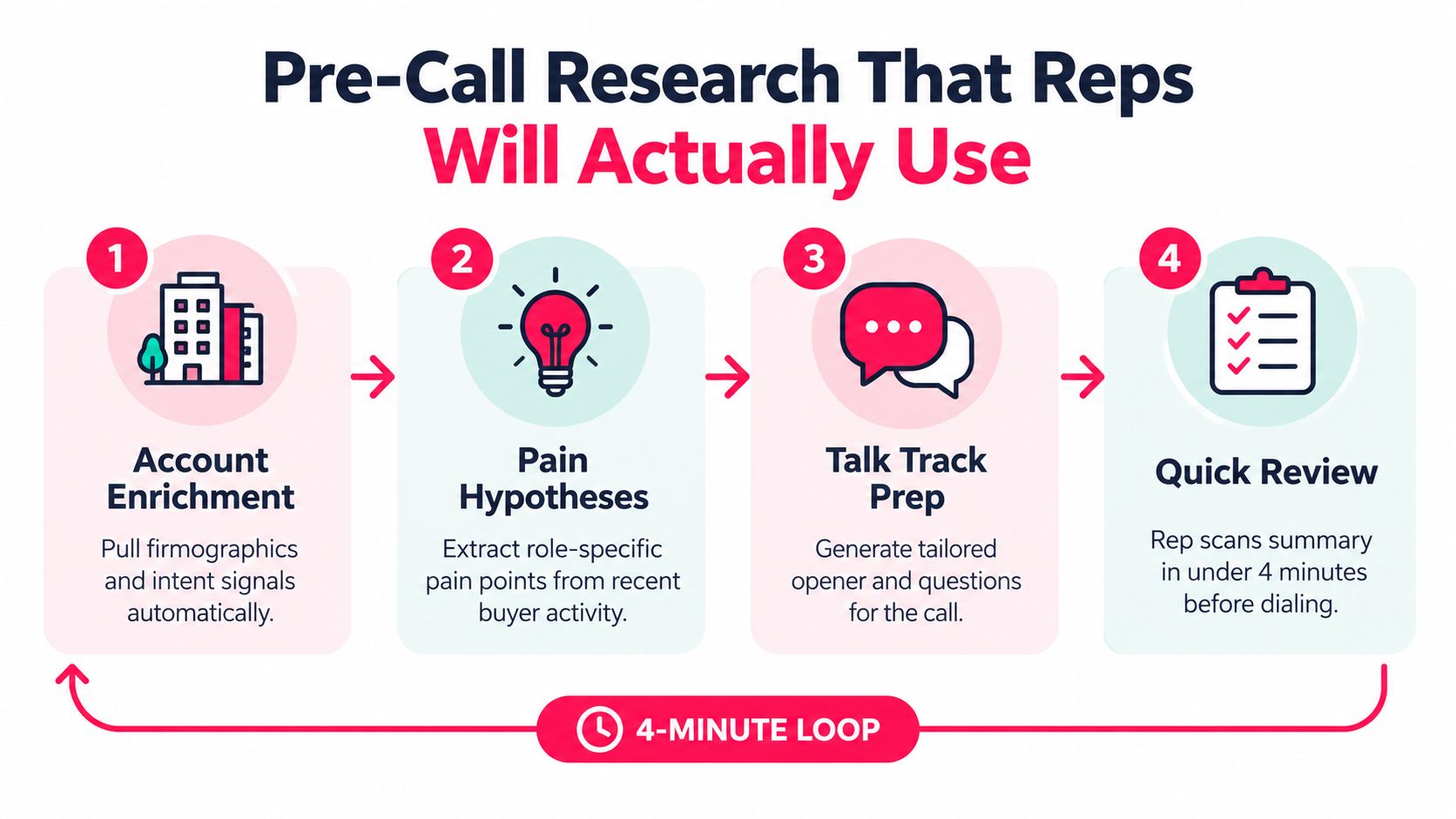
The brief should look like this
The best versions pull from LinkedIn Sales Navigator exports, 6sense intent, ZoomInfo, and prior call transcripts in Gong. We've also seen teams use a lightweight prompt in tools such as AI call prep with Yalc to generate a first-pass brief before the rep edits it. That first pass should be treated as draft input, never as truth.
A practical prompt looks like this:
- Account context: “Summarize firmographics, recent buying signals, and likely business priorities.”
- Role hypothesis: “What does a VP Sales care about here versus a RevOps lead?”
- Objection guess: “List likely pushback based on prior calls and current funnel stage.”
- Opening line: “Write one opener that references the buyer's role and a recent trigger.”
The rep then maps the result directly into CRM fields. In Salesforce, that usually means account notes, contact pain points, and a short opener field. In HubSpot, the same logic applies to company notes, deal stage notes, and next-step tasks.
What the rep should say out loud
A rep who uses the research will sound natural, not scripted. The opener should reference one specific signal, then ask a question that tests whether the AI hypothesis was right. If the AI says the buyer cares about implementation speed, the rep should ask about rollout blockers instead of reading a polished paragraph back to the prospect.
The rep edit step is the quality gate. If reps don't correct the brief, they probably didn't read it.
The failure modes are predictable. Stale enrichment creates bad assumptions, generic prompts create bland openers, and hallucinated details destroy trust fast. The manager gate is simple, spot-check the first sentence of the call opener and the first CRM note. If they don't match, the workflow is decorative, not operational.
Live Assist Without Turning Reps Into Robots
Live assist works only when it stays narrow. The screen should show a sidebar card stream with talk-track snippets, objection rebuttals, pricing rules, and competitor switches, all driven by the live transcript with low latency. The rep should still control the conversation, because the buyer is listening to the rep, not the software.

What belongs on screen
On-screen suggestions should be short and immediately usable. A rep needs the next-best-question, a risk flag, or a mutual action plan reminder. Tools such as Gong, Chorus, Cresta, and sales engagement stacks like Salesloft Drift can all support some version of this, but the configuration matters more than the logo.
Keep these on screen:
- Next-best-question prompts: Short questions tied to the buyer's last statement.
- Deal-risk flags: Competitor mention, pricing hesitation, or missing stakeholder cues.
- Mutual action plan checkboxes: Simple reminders that keep the call moving.
Keep these off screen:
- Long-form answers: Reps won't read them mid-call.
- Full call summaries: Those belong after the call.
- Dense scripts: They pull the rep out of the conversation.
The rep override model matters too. If the prompt is wrong, the rep should ignore it instantly, with no friction. In our client work, the best teams treat the AI as a suggestion layer, not a script engine. That also means the mute-when-suggesting rule matters, because reps shouldn't be talking over the customer while reading from the sidebar.
Discovery and closing need different prompts
Discovery prompts should open the conversation. Closing prompts should narrow it. A discovery prompt may ask about priorities, while a closing prompt should clarify process, timing, or decision path. If the same prompt set is used in both stages, the call tends to get noisy and repetitive.
An outside example worth reviewing is the hands-free customer inquiry assistant from Expressify AI, because it shows how voice-led support can work when the interface stays minimal. That kind of narrow design is the right mental model for sales calls too.
Managers should audit three settings weekly, latency target, suggestion density cap, and whether every accepted prompt gets reviewed by a human. If the assistant is slow, crowded, or unreviewed, it turns into background clutter instead of a coach.
Outbound AI Voice Agents and the Conversion Math
Outbound voice is where most of the hype lives and where most of the waste shows up. The reason is simple, a voice agent can increase dialing speed, but it can't fix a weak list or a vague offer. The practical benchmark is still the channel baseline, which means B2B outbound connect rates of 6% to 12% are the ceiling most are working inside, not beyond it per the 2026 benchmark summary.
The scenario that matters most
AI callers do best when the list is high-volume and low-fit, where human reps would burn out first. They tend to lose when the buyer already showed intent, when the deal has multiple stakeholders, or when discovery needs real follow-up. The useful comparison is between cold lists, scored leads, and post-event outreach, because the math changes fast.
| Scenario | Human SDR Connect Rate | AI Agent Connect Rate | Qual-to-Meeting | Cost/Meeting |
|---|---|---|---|---|
| Cold cold-call to unqualified list | Lower on abandoned volume | Higher when volume is the goal | Usually weak unless the offer is sharp | Only helps if labor is the bottleneck |
| Cold call to scored MQL | Better when context is warm | Can work if routing is fast | Stronger with human handoff | Drops when qualification is binary |
| Post-event outreach | Better for nuanced follow-up | Works for quick routing and basic qualification | Strong when intent is already visible | Best when talk-time stays short |
The key constraint is time. Cost per meeting falls only when talk-time stays very short and qualification is binary. That's why AI agents can help with simple yes-no routing, but they struggle when the call needs exploratory selling. A source tied to recent benchmark data reported that the best-reported AI calling conversion reached 4.7% when teams used high-intent lists, personalized scripts, and immediate human handoff, which lines up with what we see in practice: the handoff is doing real work as reported in the 2026 benchmark.
Kill criteria: if the first 30 seconds produce too many hangs, the opener is wrong, not the model.
A practical routing rule is essential. If an AI-qualified lead doesn't land with a human within 60 seconds, the lead cools and the value drops. That's why outbound voice works best as a router and qualifier, not a full replacement for SDR judgment.
Post-Call Summaries, CRM Hygiene, and Follow-Up Triggers
Post-call value comes from what gets written into the system of record, not from a pretty summary sitting in an inbox. We've seen too many teams celebrate transcription quality while their pipeline stays messy. The summary has to populate next steps, pain verbatim, budget signal, and competitor mention or it isn't doing the job.
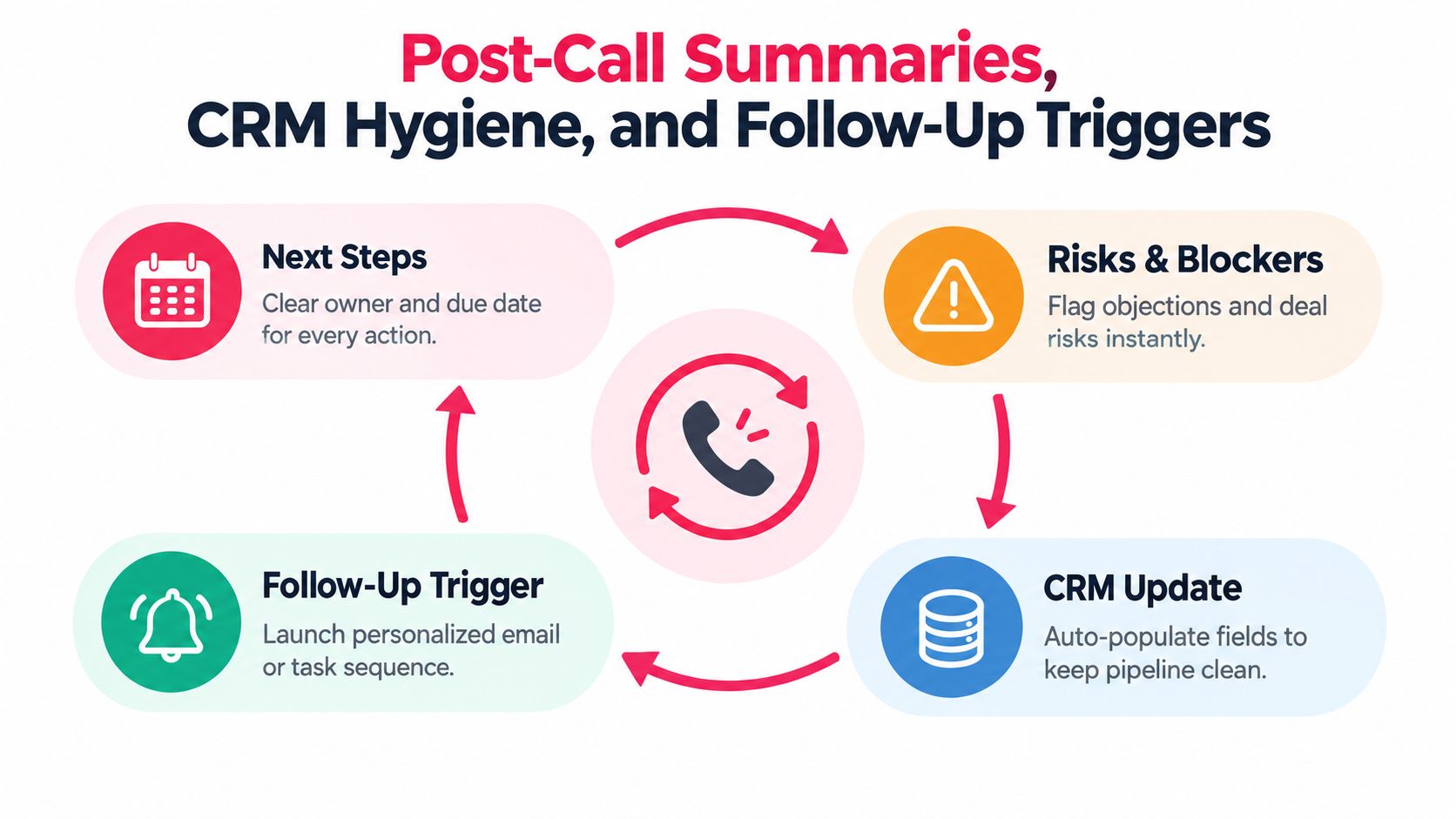
The workflow should be short and forced
The rep should get 90 seconds to edit the draft summary, then the record either syncs or goes to a human QA queue. If the call scores below 0.7 confidence on action items, a human verifier checks it before sync. That's the right place for judgment because the cost of bad CRM data compounds quickly.
The follow-up triggers should be simple:
- Meeting booked: move the lead to calendar invite plus sequence exit.
- Pricing discussed: route to the AE within five minutes.
- Churn risk language: send to customer success immediately.
The recap email should stay short too. Under 120 words, three bullets, one CTA, and sent within 10 minutes of call end is enough. Anything longer gets buried, and anything later feels detached from the conversation.
Why this matters operationally
One of the recurring findings in sales-call work is that summaries are often generated and never read. That kills the whole ROI because the team thinks it has automation when it really has storage. Stimulead's own work on CRM hygiene agents shows the same pattern, normalize the notes, but keep the human accountable for what matters.
The best managers ask one question after the call, what did the system do with the next step? If the answer is “nothing,” the stack is generating admin, not momentum.
What Does Not Work About AI Sales Calls
Most AI calling programs fail for the same reason. Leaders buy automation to replace SDR labor, then judge success by dials, transcripts, or total conversations instead of pipeline movement. That's how ai sales calls become a theater of motion.
The three most common anti-patterns are easy to spot.
- Aged lists: AI is pointed at contacts humans already burned, so the system scales bad inputs.
- Empty bragging: teams celebrate conversations held, but no qualified next step lands in the CRM.
- No verification: summaries auto-write into CRM without a human checking action items.
The clean diagnostic is to split outputs into pipeline moved and noise generated. If pipeline per dollar of AI spend is still below the human SDR baseline by month two, the program is decoration. There's no point arguing about model quality if the list, offer, and routing are weak.
A contrarian source makes the same broader point. It notes that personalized AI-driven calls can lift meeting conversion, while cold-calling success rates overall moved only modestly, and raw reply rates can fall even as outbound volume rises per recent reporting on AI sales voice calling. That's the hard truth, AI often reveals bad list strategy and weak offers faster than a human rep ever would.
Compliance, Governance, and a Vendor Evaluation Checklist
Two-party consent changes the operating model immediately. One source identifies 11 U.S. states plus the District of Columbia as all-party consent jurisdictions, and says if an AI voice agent records calls for quality assurance, training, or compliance logging, the disclosure has to be given at the beginning of the call in those jurisdictions per Thoughtly's compliance checklist. For teams evaluating platforms, that's not a legal footnote, it's a deployment gate.
The minimum record you need
A defensible consent record needs more than a generic recording notice. It should capture who consented, when they consented, what they consented to, and how they consented, and the stronger guides also preserve the exact disclosure language, the timestamp, the affirmative action, and, where applicable, an IP address or device identifier as described in TurboCall's compliance guide.
That record should sync into Salesforce or HubSpot fields that compliance and RevOps can audit later. If the log lives only inside the vendor's dashboard, it's too fragile for real governance.
Vendor checklist RevOps should run
- Data residency: Know where call data is stored.
- Model training opt-out: Confirm your data won't train the vendor's general model.
- PII redaction: Make sure transcripts scrub sensitive fields.
- SOC 2 Type II: Ask for the report, not a promise.
- Breach notification SLA: Know the clock before you sign.
- Right-to-delete honoring: Check that deletion requests are handled cleanly.
- State-level feature controls: Verify AI voice can be disabled where consent rules demand it.
For a practical comparison view, our team often sends buyers to compare AI sales platforms so they can pressure-test vendors against the same checklist before procurement gets emotional. Our internal Stimulead guidance on AI governance best practices covers the operating cadence we use with clients, quarterly audits, rep training, and a kill-switch procedure that preserves call history when a vendor gets retired.
The right vendor is the one your legal, RevOps, and sales leaders can all live with after the pilot. If any one of them can't answer the disclosure, retention, or deletion questions, the rollout isn't ready.
If you're deciding where ai sales calls belong in your stack, start with one workflow, one owner, and one clean success metric. Pick the lane that fits your current bottleneck, then ask Stimulead for a vendor review or a workflow audit before you scale it across the team.